
Which kitchen tools are worth a splurge?
Spend on the jobs you do repeatedly. Save on the tools that mostly take up space.
A thoughtful 10-minute buying plan
A budget, your available storage, and an honest list of what you cook.
Improve the everyday bottleneck first
A comfortable, maintainable knife and a stable board can be more useful than a giant knife set. Handle sizes and weight are personal. A higher price is not proof that a tool will feel better in your hands.
Choose temperature confidence
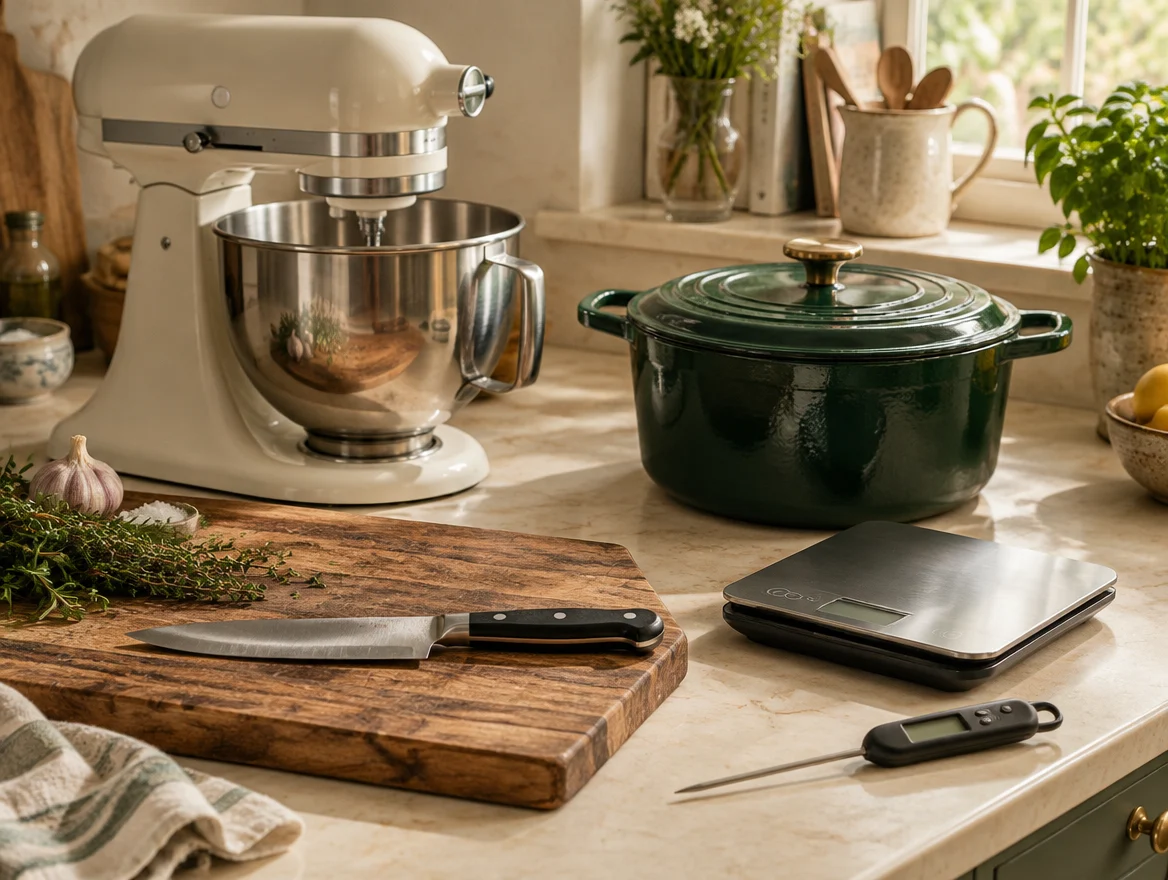
A reliable instant-read thermometer is a sensible priority when cooking meat, poultry, or casseroles. Compare the readable display, probe placement instructions, response, care, and warranty—not just a long feature list.
Upgrade the pan you reach for
A sturdy skillet that heats evenly or a durable rimmed baking sheet may earn its place quickly. Consider stove compatibility, weight when full, handle comfort, and cleaning. An expensive pan is not a replacement for learning heat control.
Buy a stand mixer for a real habit
A stand mixer can be worthwhile for frequent bread, enriched dough, or repeated batches. An occasional batch of cookies may be well served by a hand mixer. Check bowl capacity, storage space, and manufacturer limits before expecting it to knead every dough.
Think carefully about specialty gear
A Dutch oven can cover soups, braises, and some breads, but it is heavy. A cake turntable is useful for someone who decorates regularly; it need not be elaborate. A processor or blender earns its space only when its tasks appear in your weekly cooking.
Keep the inexpensive things inexpensive
Simple mixing bowls, silicone spatulas, measuring spoons, and cookie cutters often do not need luxury prices. Avoid giant single-purpose gadget sets. Compare replacement parts and maintenance costs, and borrow an occasional-use item before buying it.
Try one little thing.
Name one tool you use weekly and one tool you can skip.
Choose a printable for the adventure →